Companies that outgrew the connections between their systems.
Most of the companies we work with are past the startup stage but not enterprise-sized — large enough that no one person sees the whole system, small enough that a focused plan can change things quickly.
We approach it the way a city planner would. The buildings are fine; the roads between them were never planned. So we map what's there today and plan the connections, starting from what you already have rather than a rebuild.
Read how we see the work →Where the gaps show up.
None of these is a software problem on its own. Together, they're a sign the system was never planned as one.
Re-entering the same data
The same customer, order, or project lives in three tools, and someone keeps them in sync by hand. Every re-entry is another chance for the numbers to disagree.
Handoffs that drop things
Work crosses from sales to delivery to finance, and details fall out at each step. Customers often notice before you do.
Reports that take days
Leadership can't get a clear picture without someone pulling exports and rebuilding a spreadsheet, so decisions wait or get made without the data.
Tools people work around
A system was bought to fix this, but the team keeps a side spreadsheet anyway. The workaround shows where the design missed how work actually happens.
Listen. Map. Plan.
Listen
DiscoveryWe start with the people doing the work — across teams, not just leadership — to learn how tasks, workflows, and information actually move today, where they stall, and why the workarounds exist.
Team and stakeholder interviewsTool and workflow inventoryEarly friction themesMap
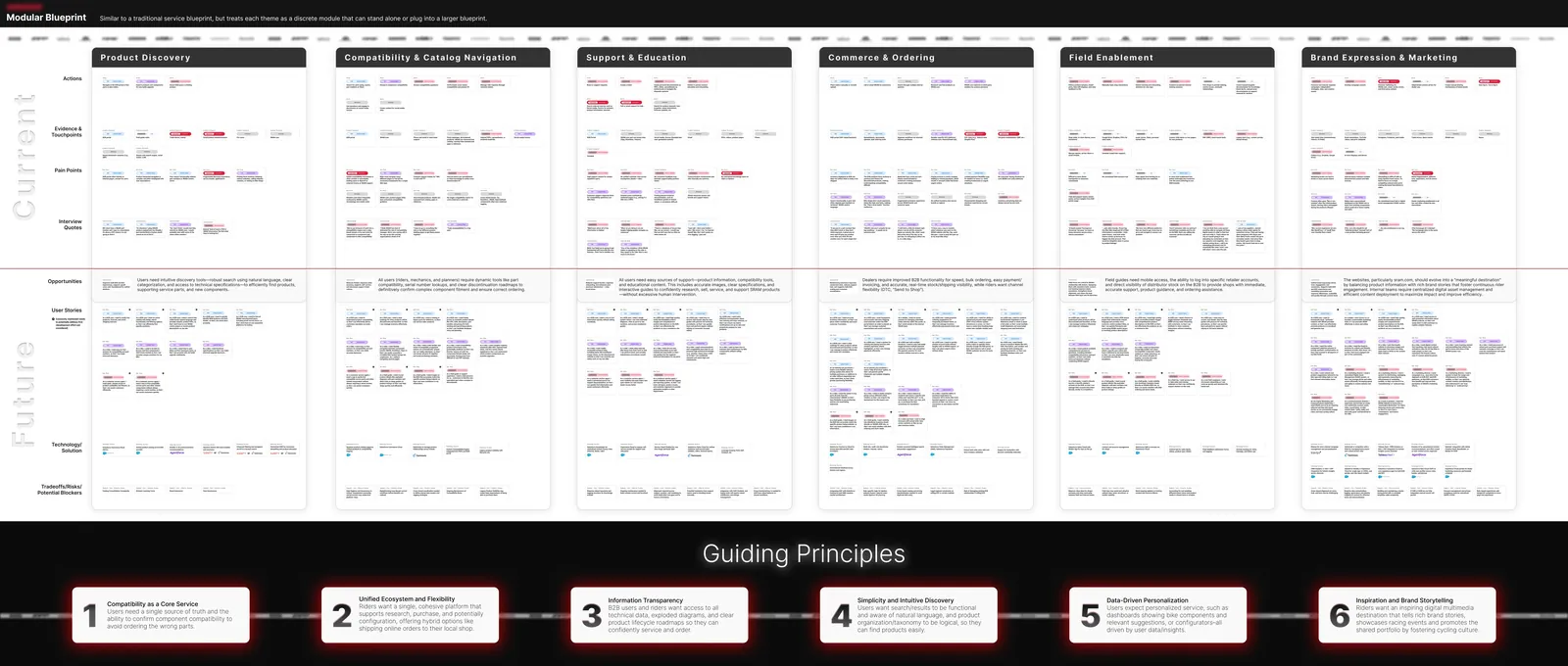
Current stateBusiness process mapping across teams, not just within one: a current-state service blueprint that shows every handoff between your people, tools, and data, and a friction inventory that shows where work gets stuck.
Current-state service blueprintFriction inventorySystems and data mapPlan
RoadmapWe turn the map into a prioritized plan — quick wins, near-term fixes, and what can wait. It starts from the tools you already have and includes systems integration planning: what to connect, buy, hire, or migrate next.
Prioritized planLeadership readout
Enterprise methods, sized for growing companies.
The research and service design methods behind this work come from years of enterprise transformation work at Boston Consulting Group and IBM iX. We apply them at the scale a growing company actually needs: a focused plan, not a multi-year program.
Start from what you have
The plan works with your existing tools first. Replacing a system is a decision the map should inform, not an assumption we start with.
You work with Lucas
From the first call through delivery. When the plan calls for engineering or automation, we bring in trusted partners and stay accountable for the result.
Sized to the problem
We won't push you toward a bigger engagement than you need. The Operations & Systems Map is a fixed-scope starting point with a published price.
 SF Commerce Cloud
Where to start.
Every offering has defined deliverables and a published starting price.
Operations & Systems Map
Your tools each do their job. The work between them is where things break. We talk with the people doing the work, map how tasks and information actually move across your teams and systems, and deliver a prioritized plan for what to fix first, before you buy, hire, or migrate anything.
Details on Operations & Systems MapResearch-to-Roadmap Package
From scattered signals to a product direction you can defend. We take your raw research — transcripts, surveys, existing data — through AI-assisted synthesis and deliver a prioritized roadmap brief that product and engineering can act on immediately.
Details on Research-to-Roadmap PackageSalesforce Adoption Audit
Your Salesforce is live. Your users aren't using it. We audit your existing implementation — gap analysis, friction inventory, prioritized quick wins — and deliver a roadmap with adoption impact estimates.
Details on Salesforce Adoption Audit